The Complete Product Launch Strategy Guide for Micro-SaaS Founders
A comprehensive product launch strategy can make or break your micro-SaaS. This guide provides indie founders with proven frameworks and actionable tactics to execute launches that actually drive customer acquisition and growth.
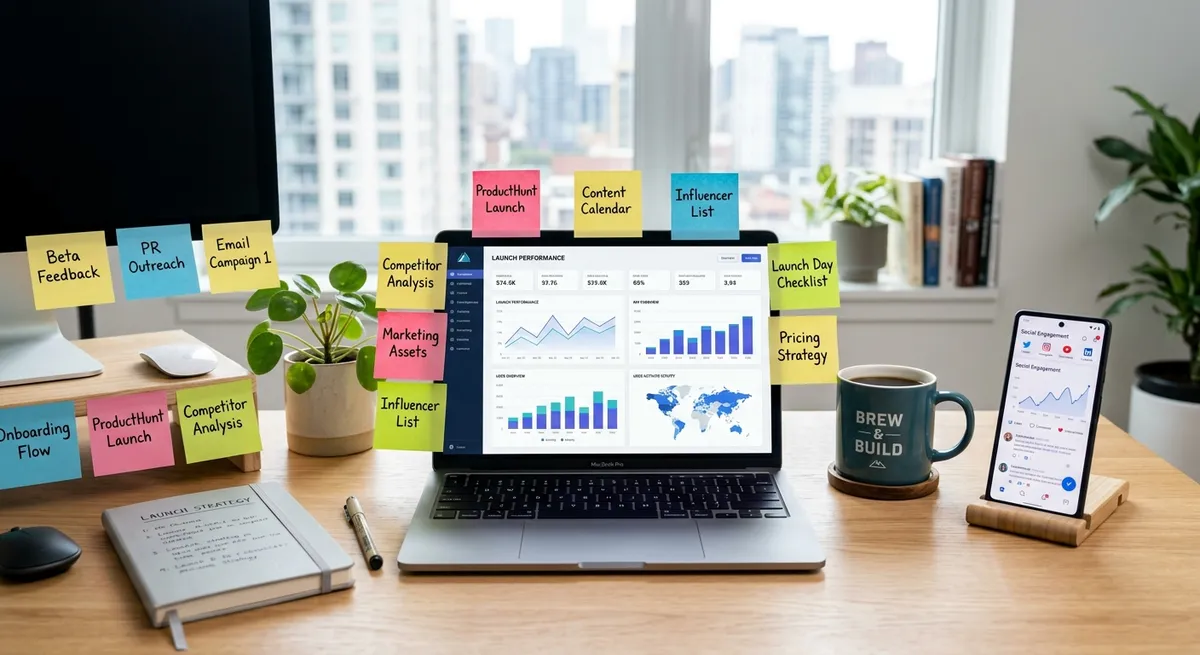
The Complete product launch strategy Guide for Micro-SaaS Founders
The key to launching your micro-SaaS lies in a rock solid product launch strategy. If your startup is to gain enough momentum to grow into a business worth pursuing, it needs to stand out. When an established enterprise is launching a SaaS product, they have budgets to work with, but the micro-SaaS founder has a completely different situation. The goal here is to create your own unique approach to launch. To accomplish this, you'll need to build systems that help you gain awareness, get feedback, and ultimately land customers.
Why Most Micro-SaaS Launches Fail (And How to Avoid It)
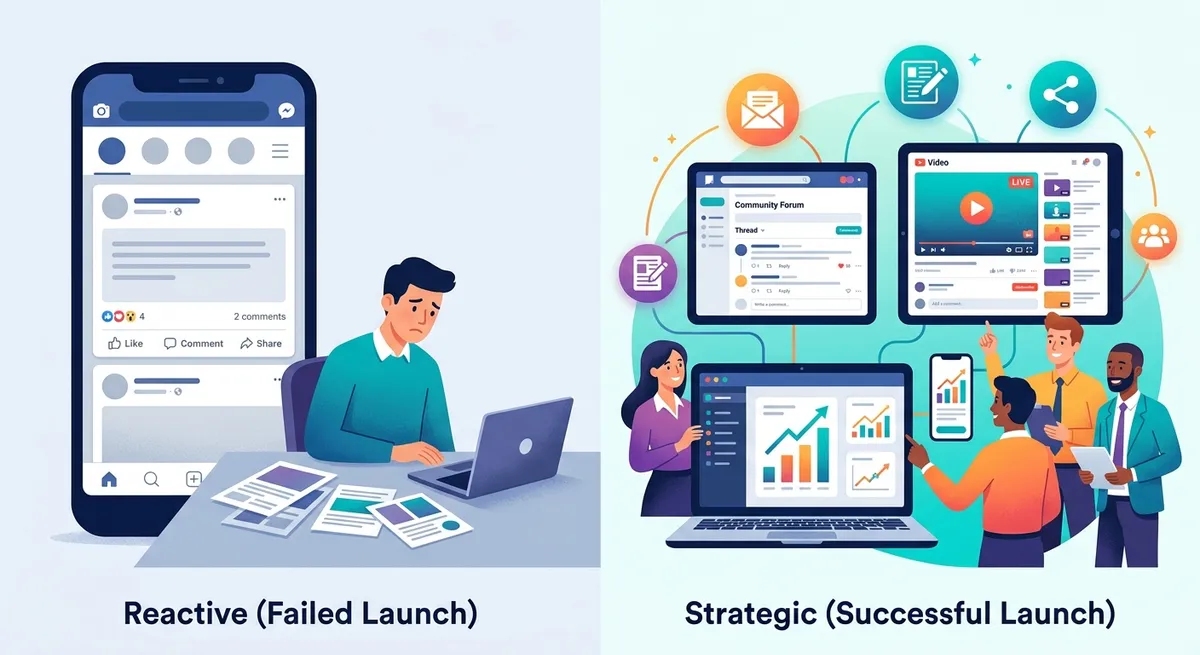
I’ve noticed indie founders often make launches a one-day thing. I mean, it happens all the time. Someone tweets about a “launch,” people drop some congrats or even see a nice bump in site visits, and that’s it. What I want you to understand is that successful launches aren’t reactive; they’re the opposite. newly launched products use launches strategically, not as an event. This involves a systematic approach weeks and months before a launch date, building up to the day and extending well past it. I mean, think about a launch as a campaign.
The Pre-Launch Foundation: Building Before You Build
Know Your Customer Avatar Inside Out
The most important thing before you start your launch strategy is to be able to articulate in detail who you are launching to. You have to know your customer avatar. It is more than a generic demographic description; it is the very specific person who is looking for the problem your micro-SaaS product solves.
To create a customer avatar, ask yourself:
- What does my micro-SaaS product improve?
- Where does this type of person spend time online?
- What other micro-SaaS products is this person currently using?
- Why does this person want to change the status quo and move to a different micro-SaaS product?
The more specific you can get in answering those questions, the more obvious the path to identifying where to find your micro-SaaS potential customers.
Start Building Your Audience Early
Launch success is dependent on having customers who already know who you are and trust your name. Start building your audience at least 3 to 6 months ahead of your launch. You don't need to try to be everywhere and all that. Instead, pick the one place where your ideal customer is most active. This may be:
- Community forums
- Online video sites
Whatever channel you choose to promote your business on, be present there regularly. Show people who you are, talk about the problem you are trying to solve, and provide consistent value in that specific social media niche.
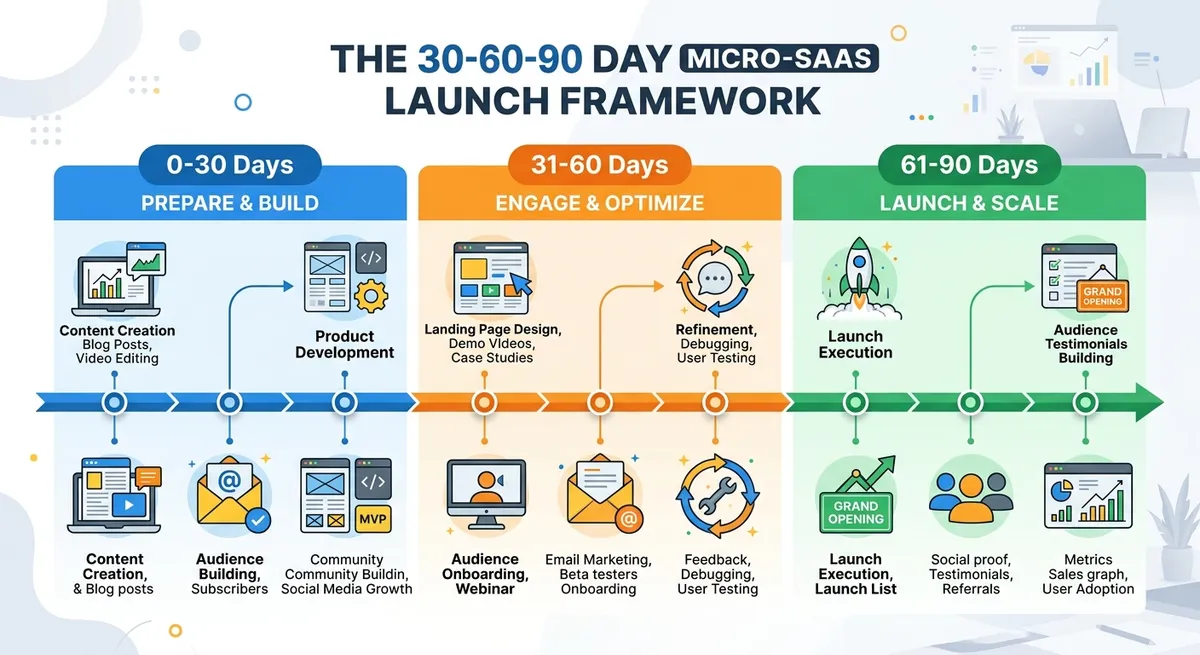
Crafting Your product launch plan: The 30-60-90 Framework
60 Days Before Foundation and content creation
This is when your launch idea really starts taking shape. It's not about any announcements or hype yet, it's all about making a solid foundation for your launch and success.
Start creating content for your launch assets including
- Demo videos of key product features
- Customer testimonials from beta testers (your friends, even if you can’t use it as one yet)
- FAQ's addressing common objections to buy
- Email lists segmented by type of user
It's also important you set up tracking at this point. You'll want to be able to measure everything from which source is bringing you most traffic to how successful conversion rates are. Most micro-SaaS founders underestimate the importance of this data to optimizing their go to market strategy after launch.
30 Days Before creating anticipation
And now you can start building the hype and anticipation around your upcoming launch. Start creating content around why you chose this problem to solve and why the existing solution doesn't work. Maybe you can provide some sneak peeks of how your product works or walk people through a demo.
Now is also a great time to start connecting with potential early users. Reach out to people you think would fit your customer avatar perfectly.
Launch Week: Execution and Amplification
Your actual launch should feel more like a natural conclusion rather than a sudden news flash. You want it to be less of a “surprise” and more of a “what were you waiting for” moment. Here’s what your launch should look like:
Launch Day 1: Announce in your email list and social channels Launch Days 2-3: Talk to communities and forums Launch Days 4-5: Reach out to other founders for a cross-promotion Launch Week: Share testimonials and early results
Don’t spam everyone at once. Make sure you’re using multiple different channels and timezones.
Content Marketing That Actually Drives Signups
Make Content Focused on the User’s Problem
The most successful micro-SaaS founders focus not on the SaaS product but on its problems, so that their micro-SaaS attracts people who can actually use it. The best way to do this is to write content around workflows your SaaS can solve, such as “how to do X”, content around a problem (“are you having issues with X?”) or content that compares a few possible ways of solving the problem (“X vs. Y”). You also need to create content demonstrating the difference your product makes, like “before and after” case studies.
Writing problem-driven content allows you to leverage customer-driven micro-SaaS marketing, as it naturally attracts people who might use your SaaS.
Use User-Generated Content
If you are new, you don’t have to wait to collect social proof from large numbers of users or well-known clients. Your early users would likely be happy to share a few screenshots or a quick testimonial or video about how they use your product. User-generated content is very effective as it is a testimony of real people using your product and benefiting from its features, which is something that even very new newly launched products are often able to do without much difficulty.
Automate Your Content Distribution
As you scale, you want your content distribution processes to function without your involvement. For example, you should automate blog-post publishing or content distribution across multiple platforms. This ensures consistent presence and saves you time while you focus on other things. Some examples of content distribution automation include:
- RSS to social automation
- Nurturing email campaigns
- Content repurposing
- Content publishing scheduling
Measuring What Matters: Launch Analytics That Guide Decisions
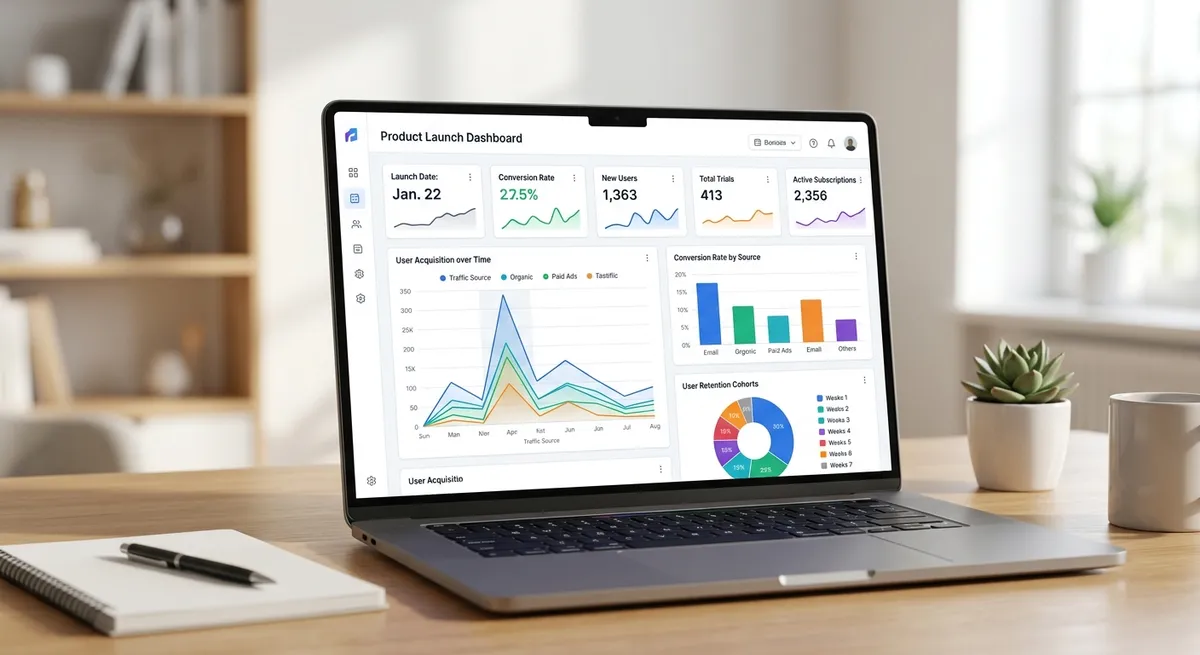
Focus on Metrics That Matter
When launching a micro-SaaS, it is crucial to distinguish between metrics that drive your business and those that simply look good on paper. You should concentrate on metrics that directly influence business growth:
Metrics about awareness:
- The number of unique visitors on your landing page
- Your reach and engagement on social media
- Open and click-through rates on emails
Metrics about conversions:
- The conversion rate on your landing page
- The conversion rate for users moving from trials to paid plans
- How long it takes to reach your first significant milestone
Metrics about retention:
- The percentage of users still using your product after seven, 30, or 90 days
- The frequency of user engagement with different features
- How much money each user contributes over their entire lifetime
Stay away from vanity metrics, such as the number of social media followers or page views, unless they correlate directly to business growth.
Adjust Based on the Data You Gather
Your initial product launch strategy is a good start but, as a launch, it is merely the starting point. The actual value comes from iterating based on information you collect about your actual customers.
Look closely at:
- The channels that attract users with the best fit for your product
- Which messages best connect with your audience
- Where people get stuck when onboarding
- Which features are used the most
Use these insights to improve all future marketing campaigns and subsequent releases of your products.
Scaling Beyond Launch: Turning Early Success into Sustainable Growth
Create the Architecture That Scales With Your Business
A launch should be seen as one stage in the lifecycle, not the whole cycle. The systems that you put in place for your first launch need to scale to carry 10x, 100x, or 1,000x more users without failing. The key is to create scalable systems that:
- Have onboarding processes that are not heavily staff-dependent.
- Give users access to self-service support and resources that lower the number of customer support requests you have to handle.
- Incorporate features that drive word-of-mouth and referrals, turning your existing users into an acquisition engine.
- Create a system for creating and publishing content that attracts qualified leads on an ongoing basis.
Prepare Your Next Launch
Each significant feature rollout, integration, or line of business addition is a reason to stage a mini-launch. Treat them with the same degree of care as your initial launches. Doing so means you don't lose momentum once you've launched your product, it keeps the product front-of-mind for your existing user base, and it gives you another chance to capture those leads and users that you don't quite have right now, or those new to the industry that were not interested the first time around.
Key Takeaways
• A launch isn’t a single event; it’s a multi-month process. • Get your audience ready and start marketing to them 3-6 months before you launch. Share helpful, valuable content in online communities and channels where your audience already exists and congregates. • Share marketing content that focuses on the problems you solve, not just on your product’s features. • Measure the right metrics, the ones that actually move the needle for your business, including conversion rate, customer retention, and customer lifetime value. • Start building the scalable systems you will need when you launch. These systems can’t all be manual. • A big launch might not happen once per quarter or per year. Treat every big feature or product update as a mini launch. • Launch success isn’t perfect execution, it’s an iterative process guided by data.